Chocolate Types in Baking: Cocoa, Bars, and Chips, and What the Percentage Means
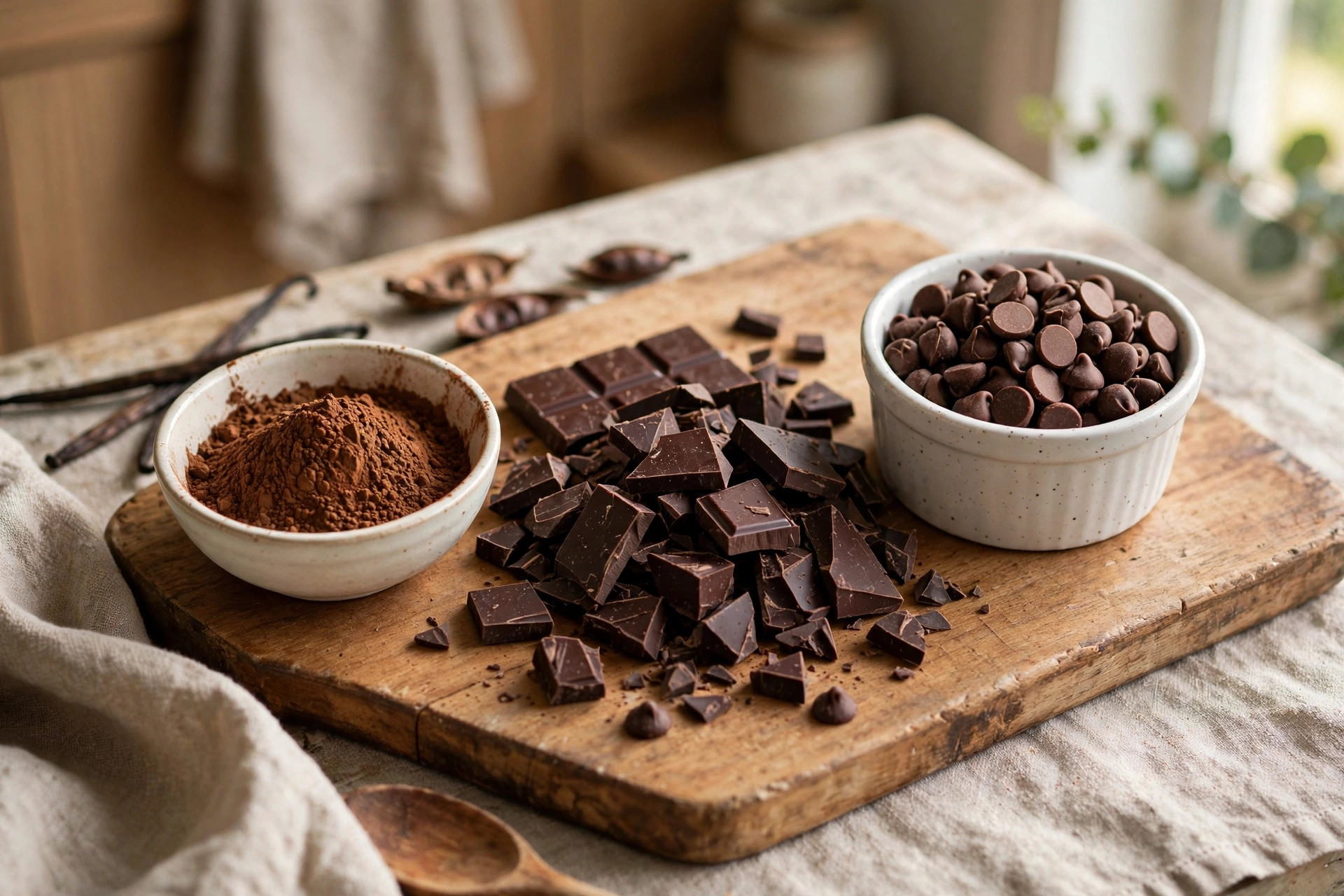
Chocolate is three ingredients in different ratios
Every chocolate product in the baking aisle is built from the same short list: cocoa solids (the dark, flavour-carrying part of the cacao bean), cocoa butter (its fat), and sugar, with milk solids joining in one branch of the family. The bewildering shelf of cocoas, bars, and chips is really just those components in different ratios and forms. Learn the ratios and the shelf reads itself: a product with all solids and no sugar behaves nothing like one with a little of each, and a powder with the fat removed cannot stand in for a bar until the fat is put back.
| Product | What is in it | Behaviour in a bake | Reach for it in |
|---|---|---|---|
| Natural cocoa powder | Cocoa solids with the cocoa butter pressed out; nothing added | Dry, intense, slightly acidic, and reactive with baking soda | Brownies and cakes leavened with soda; hot cocoa |
| Dutch-process cocoa | The same powder, treated with an alkali before or after pressing | Darker, smoother, mellower; near-neutral, so it does not react with soda | Dark cakes and cookies leavened with baking powder |
| Unsweetened baking chocolate | Pure chocolate liquor (solids plus their cocoa butter), no sugar | Bitter and intense; melts into batters as both flavour and fat | Brownies, rich cakes, frostings built from scratch |
| Semisweet / bittersweet | Chocolate liquor plus sugar and extra cocoa butter | Melts smoothly; sweetness varies by product | Ganache, mousses, chopped into cookie dough |
| Milk / sweet chocolate | Less chocolate liquor, more sugar; milk solids in milk chocolate | Mild and sweet; softer set | Gentle-flavoured bakes; rarely a recipe's main chocolate |
| Chocolate chips | Usually a semisweet-style chocolate with less cocoa butter and added stabilizers | Hold their shape in the oven; melt thick rather than fluid | Cookies and muffins where distinct pockets are the point |
Two definitions are worth pinning down because recipes lean on them. Sweet baking chocolate is defined by a floor of at least 15 percent pure chocolate (chocolate liquor), the rest is sugar, cocoa butter, and flavourings, while milk chocolate's floor is lower still, at least 10 percent chocolate liquor, alongside its milk solids. That is the structural reason milk chocolate tastes mild: there is simply less chocolate in it. And unsweetened chocolate, the reference point for the whole family, is roughly half cocoa butter by the specification baking references cite, about 50 to 58 percent, which is why it melts the way it does despite containing no sugar at all.
The percentage on the label is arithmetic
The number on a dark bar, 54%, 70%, 85%, states how much of the bar's weight comes from the cacao bean: chocolate liquor plus any added cocoa butter or cocoa solids. It is a recipe for the bar, printed on the front. And because a plain dark bar contains little else besides sugar (plus trace vanilla and emulsifier), the percentage quietly tells you the sugar content too: a 70% bar is about 30% sugar, and a 55% bar is about 45% sugar. Swapping a 70% bar into a recipe written for a 55% bar does not just deepen the flavour, it removes roughly a seventh of the bar's weight in sugar and replaces it with intense, bitter solids and fat. Sometimes that trade is delicious; it is never invisible.
Two cautions keep the number honest. First, the percentage counts cocoa butter as well as solids, and makers vary how much extra butter they add, so two bars at the same percentage can differ noticeably in sweetness and intensity, one may be butter-rich and mellow, the other lean and fierce. Percentage is a measure of quantity, not quality, and not even a precise measure of flavour. Second, the familiar names are looser than the numbers: bittersweet usually carries less sugar and more chocolate liquor than semisweet, and the two are essentially interchangeable in baking, but the terms themselves are not regulated, so a sweet 'bittersweet' from one maker can overlap a lean 'semisweet' from another. When a recipe specifies a percentage, trust the percentage; when it only names a style, either style will serve.
Cocoa powder: natural vs Dutch is a leavening question
Cocoa powder is what remains when most of the cocoa butter is pressed out of chocolate liquor and the dry cake is ground, chocolate with the fat removed, which is why it is so intensely flavoured per spoonful and why it cannot replace bar chocolate without help. It comes in two kinds. Natural cocoa is untreated: lighter in colour, sharper and fruitier in flavour, and, the fact that matters most in a recipe, slightly acidic. Dutch-process cocoa has been treated with an alkali that neutralizes that acidity, leaving it darker, smoother, and more mellow, and easier to dissolve.
The acidity is not trivia, because it plugs straight into the leavening. Natural cocoa's acid reacts with baking soda to produce carbon dioxide, so soda-leavened chocolate recipes are usually built on natural cocoa. Dutch cocoa is near-neutral and will not react with soda; a Dutch-cocoa recipe needs baking powder (or another acid) to rise. Swap Dutch into a soda recipe written for natural cocoa and the cake can come up flat and taste off-balance, the leavening was counting on acid the Dutching removed. Swap the other way, natural into a Dutch recipe, and the bake usually survives with a lighter colour and sharper flavour. When a recipe just says 'cocoa', check its leavener: soda points to natural, powder gives you a free choice.
Bars vs chips: a formulation difference, not a shape
Chocolate chips look like bar chocolate cut small. They are not. Chips are formulated with less cocoa butter and added stabilizers precisely so they hold their shape through baking, that is their job, and they do it well, standing as distinct pockets in a cookie instead of collapsing into it. The same formulation is why chips disappoint when a recipe asks for melted chocolate: melted, they stay thick and can turn waxy or gritty rather than flowing smooth, and their flavour tends to read flatter than a bar's. Bar chocolate, carrying more cocoa butter and fewer additives, melts into a fluid, glossy pool, which is why ganache, glazes, and frostings belong to bars, and why chopped bar chocolate in a cookie gives irregular puddles and flecks instead of uniform dots. Neither is 'better'; they are different tools. Chips where the shape is the point, bars where the melt is.
Substitution formulas, with their costs
Cocoa for unsweetened chocolate: for each ounce (28 g) of unsweetened chocolate, use 3 tablespoons of cocoa powder plus 1 tablespoon of butter or oil. The added fat is not optional seasoning, it replaces the cocoa butter the powder lost in the press, and without it the bake runs dry and harsh. The stand-in works best in batters that will be baked; in frostings and uncooked puddings the powder's graininess has no oven time in which to blend away. Bittersweet for unsweetened: use 1 1/2 ounces of bittersweet per ounce of unsweetened and cut the recipe's sugar by 1 tablespoon, you are borrowing the chocolate's own sugar and paying for it elsewhere in the recipe. Semisweet for bittersweet, and back: a straight swap by weight; expect a small shift in sweetness, nothing structural. Chips for bar in a melted role: possible in a pinch inside a baked batter, but the melt will be thicker and the set less smooth; in ganache or glaze, use a bar.
Run three questions before choosing. Will it be melted into the bake, or must it hold a shape? Melted points to bars and cocoa; shape points to chips. What is leavening it? Soda means natural cocoa; powder frees you to choose Dutch. How sweet should the finished bake be? Read the percentage as sugar arithmetic, higher cacao, less sugar, and adjust the recipe's added sugar only if you are deliberately changing that balance, not by accident.
Frequently asked questions
Is 'cacao' different from 'cocoa' on a label? For the percentage on a bar, the two words are used interchangeably, both refer to the bean and its parts. In ingredient lists, cocoa usually signals the processed powder or butter; the percentage math is the same either way.
Can I use drinking-cocoa or hot chocolate mix in a cake? No, those mixes are mostly sugar with a little cocoa and often milk solids and flavourings. They cannot deliver the solids a recipe is counting on. Use straight cocoa powder and the recipe's own sugar.
Why did my Dutch-cocoa cake barely rise? The likeliest cause is the leavening mismatch described above: Dutch cocoa brings no acid, so a recipe relying on baking soda reacting with natural cocoa loses that gas. Check whether the recipe pairs Dutch cocoa with baking powder; if it does not, that is the fault line.
General information only. Chocolate percentages and definitions are label conventions; check the ingredient list on the specific product in your hand.