Cake Pan Sizes and Conversions: Capacities You Can Verify
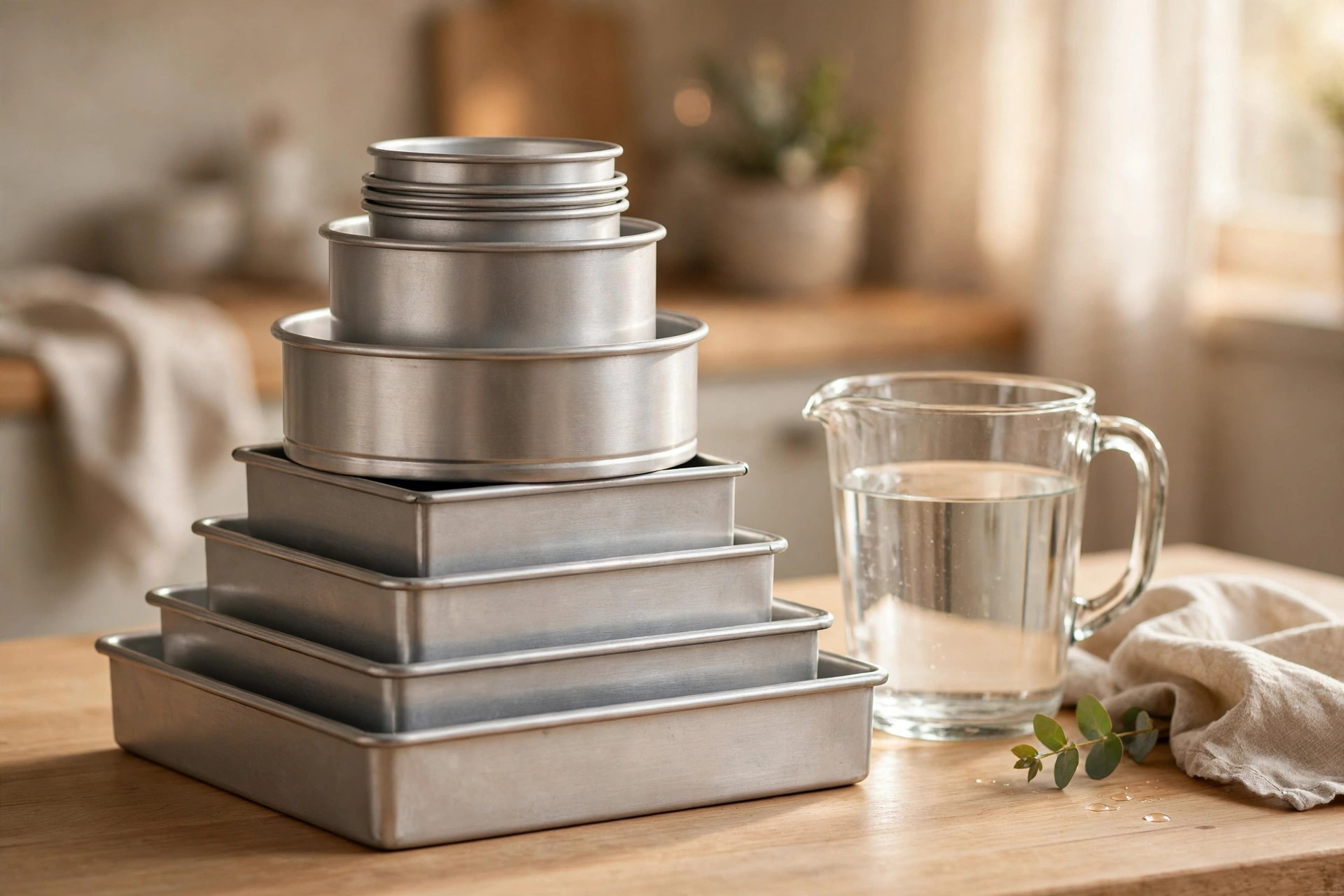
The charts disagree, here is how to know your pan's real capacity
Every pan-swap guide starts from capacity: how much batter a pan holds. The trouble is that the published charts do not agree with each other. An 8-inch round pan, the most common cake pan in North America, is listed at 4 cups by one widely circulated chart, 5 cups in passing by another, and 6 cups by a measured source. A 9×13 pan is listed at 8 cups on one page and 14 cups on the same website's other chart. Those are not rounding differences; a 50 percent error in capacity is the difference between a cake that rises to the rim and one that overflows onto the oven floor. When sources argue this loudly, the honest move is not to average them. It is to find the figures that were actually measured, and then measure your own pans.
The table below uses capacities measured in a home kitchen and cross-referenced against Joy of Baking, as published by Sally's Baking Addiction, the only top source for this topic that states both a measurement method and a cross-check. Two rules travel with every number in it. First, these are brim-full volumes: the pan filled to the very top with batter, which no cake should ever be. Second, the working fill is one-half to two-thirds full (the measured source gives both bounds in different sections; two-thirds is the ceiling either way), which leaves room for the rise. A pan's useful capacity is therefore roughly two-thirds of its listed number, an 8-inch round that 'holds 6 cups' should receive about 4 cups of batter, no more.
Verified capacities and equal-capacity swaps
| Pan | Capacity (brim-full) | Same-capacity alternatives |
|---|---|---|
| 6×2 in round | 4 cups | 8×4 in loaf |
| 8×2 in round | 6 cups | , (the halfway house; see swaps below) |
| 9×2 in round | 8 cups | 8×2 in square; 9×5 in loaf |
| 10×2 in round | 10 to 11 cups | 9×2 in square (10 cups); 11×7 in (10 cups); 10×3 in Bundt (10 to 12 cups); 9×2.5 in springform (10 cups) |
| 10×2 in square | 12 cups | 9×3 in tube pan (12 cups); 10×2.5 in springform (12 cups) |
| 9×13 in rectangular | 14 cups | Two 9×2 in rounds (8 cups each) |
Read the table by capacity, not by shape or by what the pans are called. A 9-inch round and an 8-inch square are the classic matched pair, different geometry, the same 8 cups, which is why experienced bakers swap them without a second thought. The 9×13, at 14 cups brim-full, absorbs the batter of two 9-inch rounds (16 cups combined, filled to their working two-thirds) and turns a layer cake into a sheet cake. Bundt pans are the one family to treat loosely: the standard 10-inch Bundt holds 10 to 12 cups depending on how elaborate its design is, because deep fluting displaces batter a plain ring would hold. A recipe written for a 12-cup Bundt can sulk in a decorative 10-cup one; check the pan, not the label on the box it came in years ago.
And when a chart, or this table, does not list your pan, settle it yourself. The water test below is the same method the measured source used, and it takes three minutes.
- Set the pan on a level counter and place a measuring jug of water beside it.
- Fill one cup at a time, pouring slowly and counting aloud or marking a tally on paper, until the water reaches the brim.
- Record the total. That is the pan's brim-full capacity, the number comparable to every figure in the table above.
- Mark the working fill on the pan's card or a strip of tape: two-thirds of the total is the most batter it should ever receive.
- Repeat for any pan you swap often and keep the list inside a cupboard door. One measured list ends a lifetime of chart-shopping.
What success looks like: a short written list, in your own kitchen, of the true capacities of the pans you own, every future swap becomes a comparison of two numbers you trust, instead of a guess dressed in someone else's chart.
Depth, not shape, sets the bake time
Matching capacity gets the batter into a pan that fits. It does not guarantee the same bake, because the same batter at a different depth is a different baking problem. Batter depth matters more than pan shape: spread the same volume thinner across a wider pan and the centre sets sooner; pour it deeper into a narrower pan and the centre lags while the edges overbake. This is why an equal-capacity swap still changes the clock, a 9×13 sheet version of a layer cake and the original rounds will not finish together even though the volumes match.
The working rules are simple. Keep the oven temperature the same unless the recipe itself says otherwise; depth is managed with time and attention, not heat. Begin checking for doneness earlier than the recipe states, the measured source's advice for any substituted pan, because 'earlier' is cheap and 'too late' is a dry cake. Judge by the recipe's own doneness test (a tester with a few moist crumbs, a surface that springs back) rather than by the clock, and remember that a deeper version of the same cake needs the extra minutes the centre demands, while a shallower one can be done well before the printed time. If the swap changes depth dramatically, a loaf pan standing in for a round, say, expect the largest time shift and start checking earliest there.
When no pan matches: scale the batter
Sometimes the cupboard simply has no equal-capacity pan, and the right answer is to change the amount of batter instead of forcing the fit. The math is one division: divide the capacity you need by the capacity your recipe makes, and multiply every ingredient by the result. The worked example from the measured source is a 9-inch round scaled to a 10-inch round: the 9-inch pan holds 8 cups, the 10-inch holds 10, and (10 − 8) ÷ 8 is 25 percent, so increase the batter by a quarter. Without that increase the 10-inch layers bake up thin and sad; with it, depth is preserved and so is the bake.
Scaling surfaces one awkward ingredient: the partial egg. If the factor lands mid-egg, crack the egg into a small bowl, beat it until uniform, and measure out the fraction, a beaten egg is about 3 tablespoons, so a third of an egg is 1 tablespoon of the beaten mix, or weigh the beaten egg and take the same fraction by weight. Surface area gives a second way to sanity-check a swap: multiply length by width for square and rectangular pans (a 9×13 is 117 square inches), and use radius squared times 3.14 for rounds (a 9-inch round is about 63.5 square inches, which is why one 9×13, at 117, sits so close to two 9-inch rounds at about 127 combined). When capacity and surface area both roughly agree, the swap is sound. And if the scaled batch still threatens to overflow the pans you have, bake the surplus as cupcakes alongside rather than crowding it in, a small, certain extra beats a brim-full gamble.
Frequently asked questions
Can I put a two-layer cake into one deep pan instead? Only if the deep pan's capacity matches the two pans combined and you accept a much longer, less even bake, depth is exactly what changes. Two pans at the written depth is nearly always the better bake.
My pan is 8×3 inches, not 8×2. Does the table still help? The extra inch of height adds capacity the table does not list, which is precisely the case the water test exists for. Measure it once, write it down, and treat the two-thirds rule as your fill line.
Why did my swapped cake overflow when the capacities 'matched'? Because the listed capacity is brim-full, and batter is not water, it rises. A pan filled to its full listed volume has nowhere for the rise to go. Fill to two-thirds at most.
General information only. Capacities are for the pan dimensions stated; individual pans vary, the water test is the final word for your own kitchen.