Bûche de Noël: a yule log that rolls without cracking
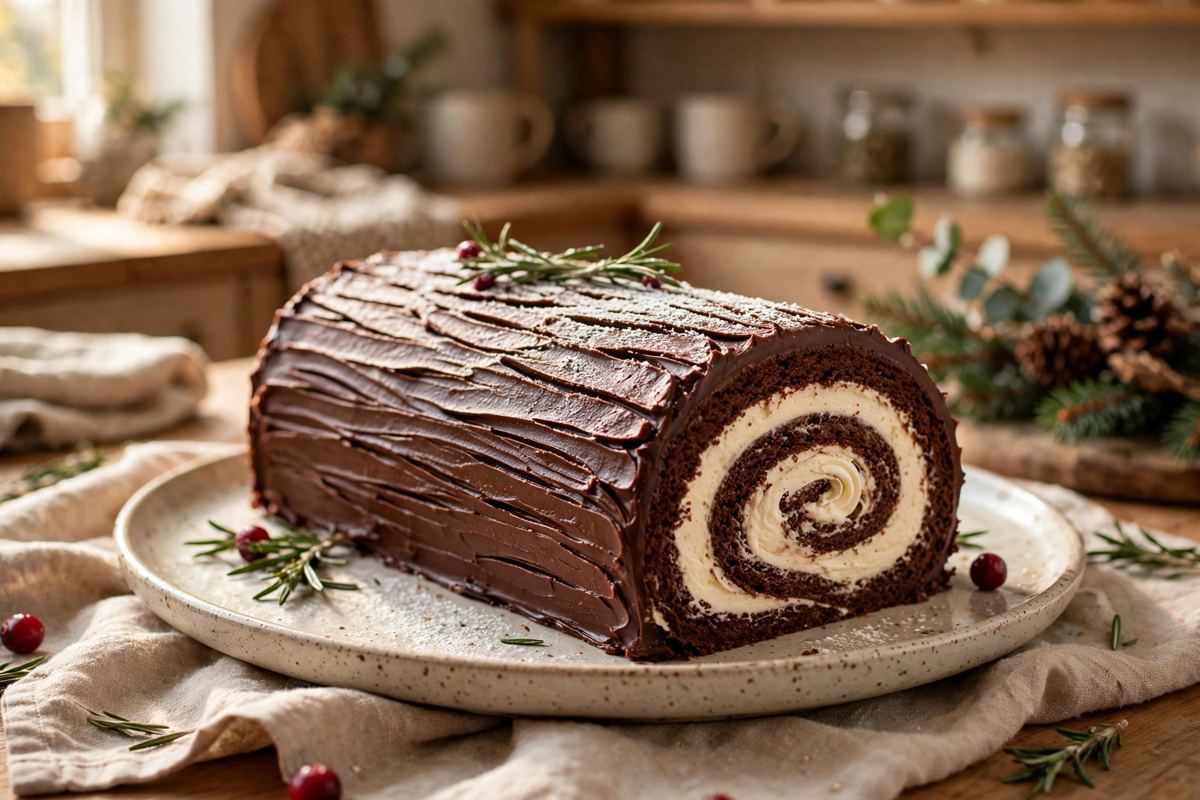
A bûche de Noël is a thin chocolate sponge cake rolled around a cream filling and covered to look like a log, and yule log is simply the English name for the same cake. A Swiss roll is the same rolled sponge without the bark finish and the Christmas dressing. Everything that makes the bûche impressive is in that roll, and everything that makes it crack is in the timing around it, which is why the method below treats the two minutes after the oven as the most important part of the recipe.
Facts: Total time about 1 hour 40 minutes plus cooling for a comparable version, with chilling spread across the day · Difficulty intermediate · Yield 1 log, serves 8 · Pan 12 by 17 inches (30 by 43 cm) · Oven 350°F (177°C)
Ingredients and equipment
For the cocoa sponge
- 1 1/3 cups (157 g) cake flour
- 2 tablespoons (10 g) unsweetened natural or Dutch process cocoa powder, plus 3 tablespoons (15 g) more for dusting the towel
- 1 teaspoon baking powder
- 1/2 teaspoon salt
- 6 large eggs, separated and at room temperature
- 1 cup (200 g) granulated sugar, divided
- 2 tablespoons (30 ml) vegetable, canola, or melted coconut oil
- 1 1/2 teaspoons pure vanilla extract
For the cocoa hazelnut whipped cream
- 1 1/2 cups (360 ml) cold heavy cream
- 2 tablespoons (30 ml) Frangelico liqueur, optional
- 1/4 cup (30 g) confectioners sugar
- 1 tablespoon (5 g) cocoa powder
- 1/2 cup (60 g) finely chopped hazelnuts, optional
For the ganache topping
- 6 ounces (170 g) semi sweet chocolate, finely chopped
- 3/4 cup (180 ml) heavy cream
Equipment: the 12 by 17 inch (30 by 43 cm) baking pan, parchment paper, an electric mixer, a thin kitchen towel or a second sheet of parchment for rolling, a fine mesh sieve for dusting, a silicone spatula, and a small offset spatula for spreading. Room temperature eggs are not a nicety here; the whites carry the sponge, and the formula separates all six eggs so the whites can be whipped on their own.
The cream is the budget line worth knowing before shopping. The filling and ganache together use 540 ml of heavy cream. A 1 litre carton of ADL 36 percent whipping cream was listed at Sobeys at $7.79 CAD on November 14, 2026, so the cream in this log costs about $4.21 of that carton, with the rest of the carton left for coffee and leftovers. Prices change; the carton size and the 540 ml total are the parts to check against a current shelf price.
The method, step by step
- Prepare the pan, about 10 minutes. Heat the oven to 350°F (177°C). Grease the pan, line it with parchment, and grease the parchment as well. The formula calls this an extremely nonstick surface, and a sponge that sticks at one corner will tear at that corner during the roll. Cue: the parchment lies flat with no bubbles and stays put when the pan is tilted.
- Whip the eggs in two bowls, about 10 minutes. Whisk the flour, cocoa, baking powder, and salt together and set aside. Beat the egg whites with 1/2 cup (100 g) of the sugar on high speed for 4 to 5 minutes. Cue: stiff peaks that stand straight when the whisk is lifted. In the same bowl, beat the yolks with the remaining sugar, the oil, and the vanilla on high for 3 to 4 minutes. Cue: the yolk mixture is thickened and visibly lighter in colour.
- Fold the batter together, about 5 minutes. Beat half the whites into the yolk mixture on low for 10 seconds, then the rest for 10 seconds more. Add the flour mixture in two additions, beating on low or folding with a spatula only until combined. Cue: no dry flour pockets and no streaks of white, with the batter still visibly light and airy. Deflated batter bakes into a dense sheet that resists rolling.
- Bake, 15 to 16 minutes at 350°F (177°C). Spread the batter evenly into every corner and tap the pan on the counter a couple of times to pop air bubbles. Cue: the top springs back when lightly poked with a finger and may look a little bubbly. Pull the sponge at that cue. An overbaked sponge cracks, and thin dry edges are where cracks start. Note that the time belongs to this pan size: a published version in a smaller format bakes 10 to 12 minutes to the same spring back cue, so the cue, not the clock, is the transferable part.
- Roll the sponge hot, within 2 minutes of the oven. While the sponge bakes, lay the towel or parchment flat and dust it with the 3 tablespoons (15 g) of cocoa through the sieve. Run a knife around the edges of the hot cake, invert it onto the dusted surface at once, and peel off the baking parchment. Starting at a narrow end, roll the hot cake up with the towel inside, slowly and gently. Cue: the roll forms without resistance and the surface shows no splits. A warm sponge bends; a cold one snaps.
- Cool completely in the roll, about 3 hours in the refrigerator and up to 1 day. The sponge is learning its shape. Cue: the unrolled sponge, when you get there, wants to curl back toward the spiral instead of lying flat and fighting you.
- Whip the filling, 2 to 3 minutes. Whip the cold cream with the Frangelico, confectioners sugar, and cocoa on medium high speed. Cue: medium to stiff peaks that hold a soft point. Cold cream whips fastest, so the cream goes from carton to bowl with no counter time in between.
- Fill and roll again, about 10 minutes. Unroll the sponge very slowly. Spread the cream evenly, leaving about a 1/2 inch (1.3 cm) border bare; a second published method leaves a full 1 inch (2.5 cm) strip at the far end, and either margin keeps the filling from squeezing out. Sprinkle the hazelnuts if using. Roll the cake back up without the towel, place it on a board, wrap, and refrigerate for at least 30 minutes and up to 2 days. Cue: the seam sits underneath and the roll holds a round profile when the wrap is snug.
- Make and thicken the ganache, about 40 minutes including chilling. Pour cream that has just begun to simmer, never a rapid boil, over the chopped chocolate. Let it sit 2 to 3 minutes, then stir slowly until completely smooth. Refrigerate uncovered for 30 minutes to 1 hour. Cue: the ganache spreads like soft butter and holds a fork line instead of running off the cake.
- Cut the branch and finish, about 15 minutes. Slice a 3 to 4 inch (8 to 10 cm) section diagonally off one end and set its angled face against the side of the log as a branch. Spread ganache over the top and sides, leaving the cut ends exposed if you like the spiral visible, and drag a fork through it in long lines for bark. Cue: the fork lines stay crisp in the thickened ganache and the spiral shows at both ends.
What success looks like: a slice shows an even spiral of sponge around cream with no cracked outer ring, the ganache bark holds its fork texture, and the log slices cleanly after chilling instead of unrolling on the board. Hairline surface cracks, if any appeared, sit hidden under the ganache, which is part of what the bark finish is for.
Storage and food safety
This is a whipped cream cake, and it lives in the refrigerator. Cover leftover cake and store it in the refrigerator for up to 3 days. The whole cake can be made 1 to 2 days in advance, covered and refrigerated, with sugared garnishes and a dusting of confectioners sugar added closest to serving. The assembled cake also freezes, before or after the ganache, for up to 3 months, and thaws in the refrigerator.
Health Canada guidance frames those recipe numbers. Keep the refrigerator at 4°C (40°F) or lower, keep food out of the danger zone between 4°C (40°F) and 60°C (140°F), and refrigerate leftovers within two hours rather than leaving them on the counter. Health Canada puts refrigerated leftovers at 2 to 3 days in general, which lines up with the 3 day limit on this cake. At a holiday table, that means the log goes back into the fridge between the dessert course and the second round of slices, not at the end of the evening.
Variations
The liqueur is the easiest dial. Frangelico can be swapped for the same amount of another liqueur, or replaced with strong cold or room temperature coffee, or with 1 teaspoon of vanilla extract or another flavour extract, which keeps the log alcohol free without changing the method. The ganache accepts white chocolate, with one adjustment: reduce the cream to 1/2 cup (120 ml) so the topping still thickens. The chopped hazelnuts in the filling are optional and can simply be left out, and the optional garnishes, meringue mushrooms and sugared cranberries and rosemary, are decoration only. Skipping them shortens the project by hours and changes nothing about whether the log rolls.
— June Callahan, Food Writer