Baking Soda vs Baking Powder: The Acid Budget Behind Every Recipe
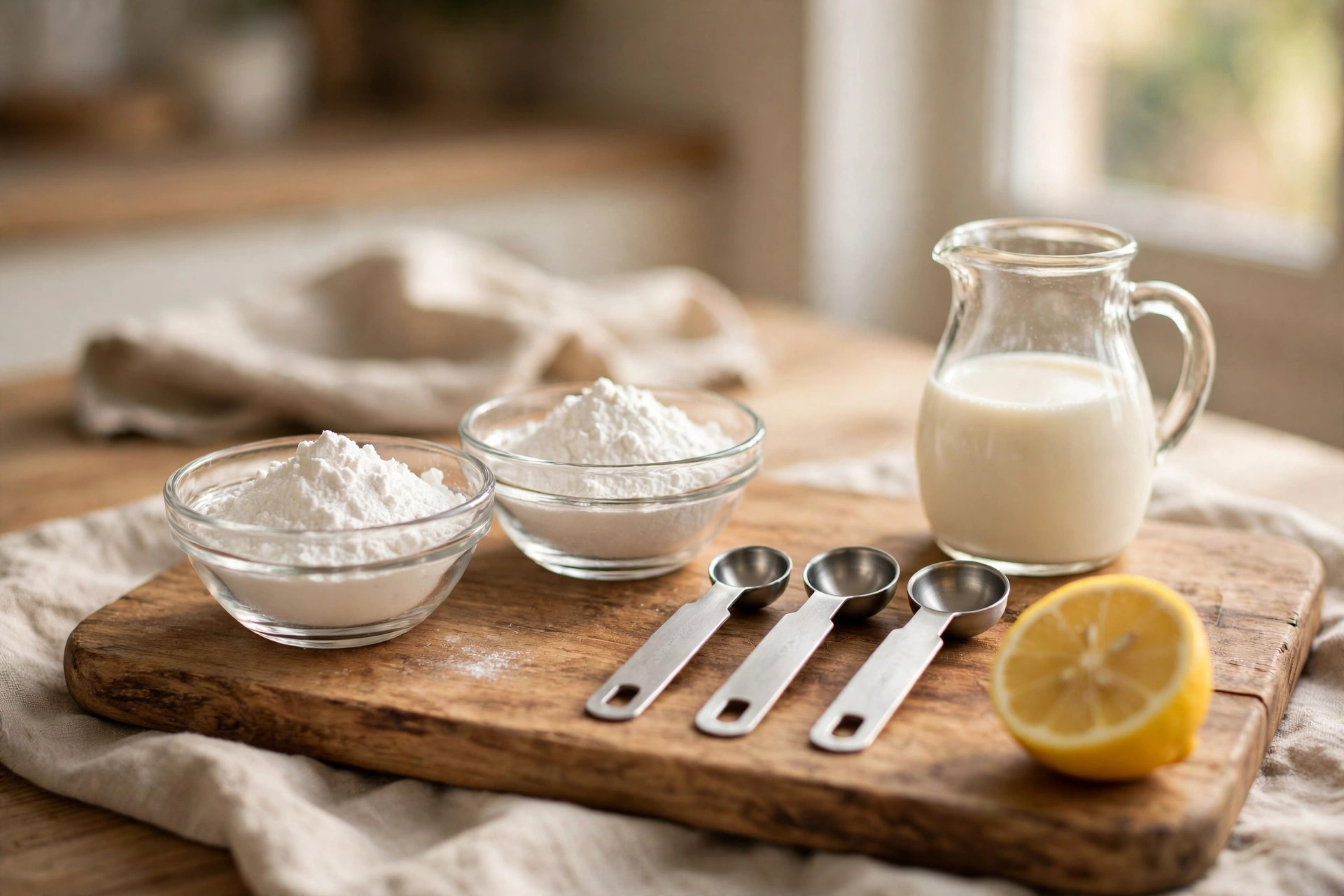
Two white powders, two different jobs
Baking soda and baking powder sit side by side in the cupboard, look identical in the spoon, and get treated as cousins. Chemically they are closer than cousins, one is literally an ingredient in the other, but they do different jobs, and swapping them by volume is one of the most reliable ways to produce a flat, bitter, or strangely browned bake. The whole distinction fits in one sentence: baking soda is a base looking for an acid, and baking powder is that same base with its acid already packed in.
Baking soda is pure sodium bicarbonate. On its own in a batter it does almost nothing useful; it needs an acidic ingredient and some liquid before it will produce the carbon dioxide that lifts a bake. Baking powder is a pre-mixed kit: sodium bicarbonate plus a dry acid, typically cream of tartar, and sometimes a little cornstarch as a drying agent to keep the mixture from reacting in the tin. Because the acid is built in, baking powder works in recipes that contain no acidic ingredient at all. Most shop-bought powder is also double-acting: it reacts once when it gets wet and again when it meets the heat of the oven, which is why a batter leavened with powder still wants to reach the oven promptly once mixed.
| Baking soda | Baking powder | |
|---|---|---|
| What it is | Pure sodium bicarbonate | Sodium bicarbonate + dry acid (usually cream of tartar), sometimes cornstarch |
| What activates it | An acid in the recipe, plus liquid | Liquid alone; double-acting types react again in the oven's heat |
| Strength | About 3 to 4 times stronger than baking powder | Milder, it is diluted by its own acid and filler |
| Rule-of-thumb dose | About 1/4 tsp per 1 cup (125 g) flour | About 1 tsp per 1 cup (125 g) flour |
| Best home | Recipes with buttermilk, yogurt, molasses, natural cocoa, lemon, or other acids | Recipes with no meaningful acid of their own |
| Failure mode | Too much for the acid present: soapy, metallic taste and over-browning | Too much: chemical taste; too little: a short, dense bake |
The acid budget: why recipes use both
The acid list is longer than most bakers expect. Buttermilk, yogurt, vinegar, and lemon juice are the obvious ones, but brown sugar, molasses, honey, applesauce, cream of tartar, and natural cocoa powder all bring acid to a batter too. When a recipe pairs baking soda with any of these, the soda has two jobs: neutralize some of that acid and convert the reaction into lift. The dose is the giveaway, roughly a quarter teaspoon of soda per cup of flour is sized to the acid a typical recipe carries, not to the size of the cake.
So why do so many recipes call for both soda and powder? Because the acid budget often does not balance. Sometimes the recipe contains acid, but not enough of it: soda matched to that acid produces some carbon dioxide, just not enough to leaven the whole volume of batter, so baking powder supplies the remaining lift without demanding more acid. Sometimes the problem runs the other way. Buttermilk pancakes are the classic case: the buttermilk is there partly for its tang, and if soda alone did all the leavening it would neutralize all of that acid, the pancakes would rise and taste flat. Adding powder, which brings its own acid, lifts the batter while leaving some of the buttermilk's flavour standing. Soda also earns its place for a second, quieter reason: it raises the batter's pH, and a more alkaline batter browns faster and deeper in the oven. A recipe can want a little soda for colour and flavour even when powder is doing most of the lifting.
The balance is not decorative. In a side-by-side cupcake test published by Sally's Baking Addiction, the batch made with only baking powder, no soda, rose less, browned too little, and came out gummy and dense, while the batch made with only baking soda browned too much, sank in the middle, and tasted awful, because there was not enough acid in the batter to neutralize that much soda. The recipe's split between the two was the version that worked. When a recipe lists both, it is arithmetic, not indecision: follow it as written.
Substitution rules and what overshooting costs
Because soda is roughly three to four times stronger than powder, the two never swap one-for-one in either direction. Replace powder with an equal amount of soda and the batter gets far more base than its acid can handle; replace soda with an equal amount of powder and the bake is under-leavened and may keep an acid tang the soda was meant to soften. If a genuine emergency forces a substitution, the workable direction is powder-from-soda: about 1/4 teaspoon of baking soda plus 1/2 teaspoon of cream of tartar stands in for 1 teaspoon of baking powder, with an optional 1/4 teaspoon of cornstarch to mimic the commercial mix. Treat it as a rescue, not a routine, the reaction timing of a homemade mix is less forgiving than double-acting powder.
Overshooting soda has a signature. Soda that finds no acid to react with stays in the crumb as an alkaline residue, and it tastes metallic and soapy; the same excess alkalinity pushes browning too far, so the bake darkens before the centre is done. Overshooting powder is less dramatic but still real: a chemical, bitter edge and a rise that can outrun the batter's structure and then collapse. The practical defence is measuring leaveners the way this site measures everything else that matters, level spoonfuls, not heaped ones, and the dose the recipe states rather than a confident extra pinch for luck. Extra leavener is not extra lift; past the acid budget, it is only extra flavour damage.
Test your leaveners before you blame the recipe
Leaveners also expire quietly. Baking powder typically stays effective for about 6 to 12 months once opened, while baking soda keeps far longer if it stays dry, but 'far longer' is not 'forever', and one widely followed safety rule is to replace both about every 3 months after opening if you bake often and want certainty. Before an important bake, run the two-minute test below (procedure adapted from King Arthur Baking's freshness guide). It costs a teaspoon of each and settles the question the date stamp cannot.
- Test the soda. Put 1 tablespoon of vinegar in a small bowl and stir in 1/2 teaspoon of baking soda.
- Read the soda. A vigorous, immediate fizz means the soda is active. A gentle, lazy, or absent fizz means it has faded, replace it before it flattens a bake.
- Test the powder. Put 2 tablespoons of warm water in a clean bowl and stir in 1/2 teaspoon of baking powder. No vinegar, the powder carries its own acid, so water alone is the correct trigger.
- Read the powder. The mixture should bubble and foam. Expect a calmer reaction than the soda test; definite bubbling is a pass, a few tired bubbles or silence is a fail.
- Act on the result. Bake with anything that passed. Retire anything that failed to cleaning duty, and write the opening date on the new tin so the next test starts from information, not archaeology.
What success looks like: both bowls react on contact, the soda foaming hard against the vinegar, the powder bubbling steadily in warm water, and you go into the recipe knowing the lift is real. If either bowl sits quiet, you have found the problem before it cost you a cake.
Frequently asked questions
Can I leave the soda out of a recipe that also has powder? Not safely. The soda is usually there to neutralize a specific acid and to help browning; dropping it leaves the batter more acidic and paler, and the powder alone may not restore the intended flavour balance.
My cookies spread and taste soapy. Is that the soda? Very likely too much soda for the acid in the dough, or soda measured heaped. Excess soda both tastes soapy and encourages spread and darkening. Level the spoon and check the recipe's acid is actually present in the amount written.
Is 'bicarbonate of soda' the same thing? Yes, bicarbonate of soda, baking soda, and sodium bicarbonate are three names for the one compound. None of them is baking powder.
General information only. Follow the recipe you are baking from for quantities specific to that batter.